 The DGX AI Access Brief
May 4, 2026
AI Isn’t Killing Jobs. Lack of Access Is.
From The AI Access Brief archive · originally published 2026-05-04
In the race for AI dominance, access, not ability, will decide who wins.
The headlines are getting louder.
Layoffs. Automation. Entire roles quietly disappearing from job boards.
Companies announce cuts, mention AI, and their stock goes up.
That’s not a coincidence. That’s a signal.
A signal that something deeper is happening beneath the surface of the economy.
We’re being told a simple story:
AI is replacing workers.
But that’s not the full truth.
Not even close.
Fear Is Real.
Across industries, the pattern is becoming hard to ignore.
Entry-level roles shrinking. Mid-level positions consolidating.
Graduates are sending out hundreds of applications with no response.
Meanwhile, executives are under pressure to “implement AI.”
Not because it’s fully ready. Not because it’s perfect.
But because the market rewards the belief that it can replace people.
So, companies move early.
They cut first. Figure it out later.
And just like that, a feedback loop forms:
Layoffs → “AI efficiency” → stock increases → more layoffs.
A system that accelerates itself.
The Hidden Truth No One Is Saying.
This isn’t happening because AI is unstoppable.
It’s happening because access is controlled.
That’s the part missing from almost every conversation.
AI isn’t evenly distributed. It’s not universally understood.
It’s not embedded into most people’s daily workflow.
Right now, AI is concentrated in the hands of:
- Companies that can afford to deploy it.
- Individuals who know how to use it.
- Institutions that are already ahead of the curve.
Everyone else?
They’re expected to catch up, somehow, without tools, training, or support.
The Real Divide.
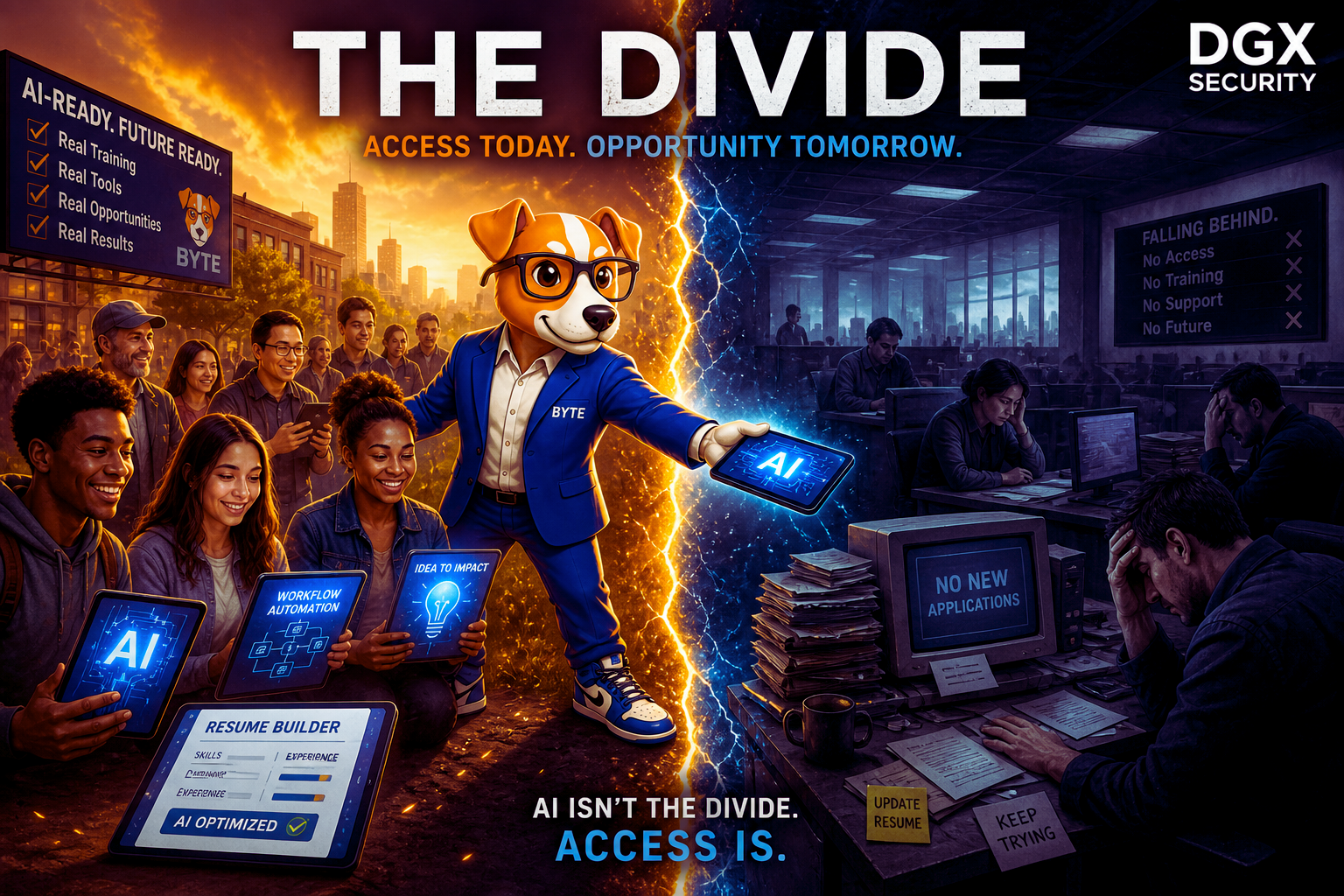
We’ve been framing this wrong. It’s not: Human vs AI.
It’s: AI users vs non-users.
That’s the new line being drawn across the economy.
On one side:
People who can use AI to write faster, analyze data, automate tasks, and create leverage.
On the other:
People who are still doing everything manually are competing against those who aren’t.
Same intelligence. Same potential.
Different access.
And in this new economy, that difference is everything.
The Missed Opportunity.
Here’s what’s wild:
Everyone sees the disruption.
Almost no one is building the solution at scale.
We hear debates about:
- Regulation
- Job retraining
- Economic safety nets
But there is almost nothing about deployment systems.
No one is asking:
- How do we get AI into people’s hands today?
- How do we make it usable, not theoretical?
- How do we connect it directly to income, employment, and productivity?
Because access isn’t just about having a tool.
It’s about having:
- The device
- The training
- The real-world application
- The support to actually use it
Without that, AI isn’t empowering people.
It’s excluding them.
What Comes Next.
The future won’t be decided by who builds the best AI models.
It will be decided by who deploys them into real communities.
Who turns:
Access → Skills → Income
At scale.
Because if we get this wrong, the divide grows:
A small group with exponential leverage. A large group trying to keep up.
But if we get it right?
We don’t just avoid displacement. We unlock something far more powerful:
A workforce that is faster, more capable, and more competitive than ever before.
A Different Approach.
The conversation doesn’t need more fear. It needs infrastructure.
It needs systems that:
- Put AI-ready devices directly into people’s hands.
- Teach practical, real-world usage, not theory.
- Connect skills to actual economic outcomes.
- Provide structured support beyond day one.
Because this isn’t about teaching people about AI.
It’s about helping them use it to move forward.
The Bottom Line.
AI isn’t replacing people. It’s dividing them.
Into those who have access, and those who don’t.
And in the race that’s already underway, the winners won’t be the smartest.
They’ll be the most equipped.
If this sparked something, send it forward.
The full archive is for those who want the whole story and what’s coming next.
Get the next issue: