 The DGX AI Access Brief
August 26, 2026
America Cannot Win the AI Race While Millions of Americans Remain on the Sidelines.
From The AI Access Brief archive · originally published 2026-08-26
China Is Building an AI Ecosystem, America Must Build One That Includes Everyone.
NVIDIA CEO Jensen Huang recently delivered a warning that should stop every American policymaker, educator**,** and business leader in their tracks:
Nine of the world’s ten leading science and technology institutions are now in China.
The claim appears to reference the 2026 Nature Index, which measures contributions to high-quality scientific research.
Chinese institutions now occupy nine of its top ten overall positions. Harvard University is the only American institution remaining in that group.
This is not simply another university ranking.
It is evidence of a historic transfer of scientific capacity and the emergence of a powerful, interconnected AI ecosystem.
For much of the twentieth century, the United States built the world’s most productive innovation system.
We invested in public education, research universities, laboratories, infrastructure and basic science.
We attracted talented people from around the world and gave them opportunities to build.
That system produced the semiconductor industry, the Internet, GPS, modern biotechnology and many of the foundations of artificial intelligence.
But leadership is never permanent.
China studied the American model, invested aggressively and scaled it across an enormous population. Its universities expanded. Its research institutions multiplied.
Its engineering workforce grew.
Scientific development became a national priority rather than a collection of disconnected projects.
The results are now impossible to ignore.
According to the U.S. National Science Foundation, China surpassed the United States in total research and development activity in 2024 after adjusting expenditures for international comparability.
China performed approximately $1.028 trillion in R&D, compared with $1.009 trillion in the United States. Together, the two countries accounted for nearly 60 percent of global R&D, according to the National Science Foundation.
China also leads the world in the volume of scientific publications.
In artificial intelligence, Stanford University’s 2026 AI Index reports that China leads in research publications, citations, and patent grants.
The United States still leads in the development of notable frontier AI models and produces patents with greater average impact, but that lead should not create complacency.
Stanford AI Index. Our greatest vulnerability is underneath.
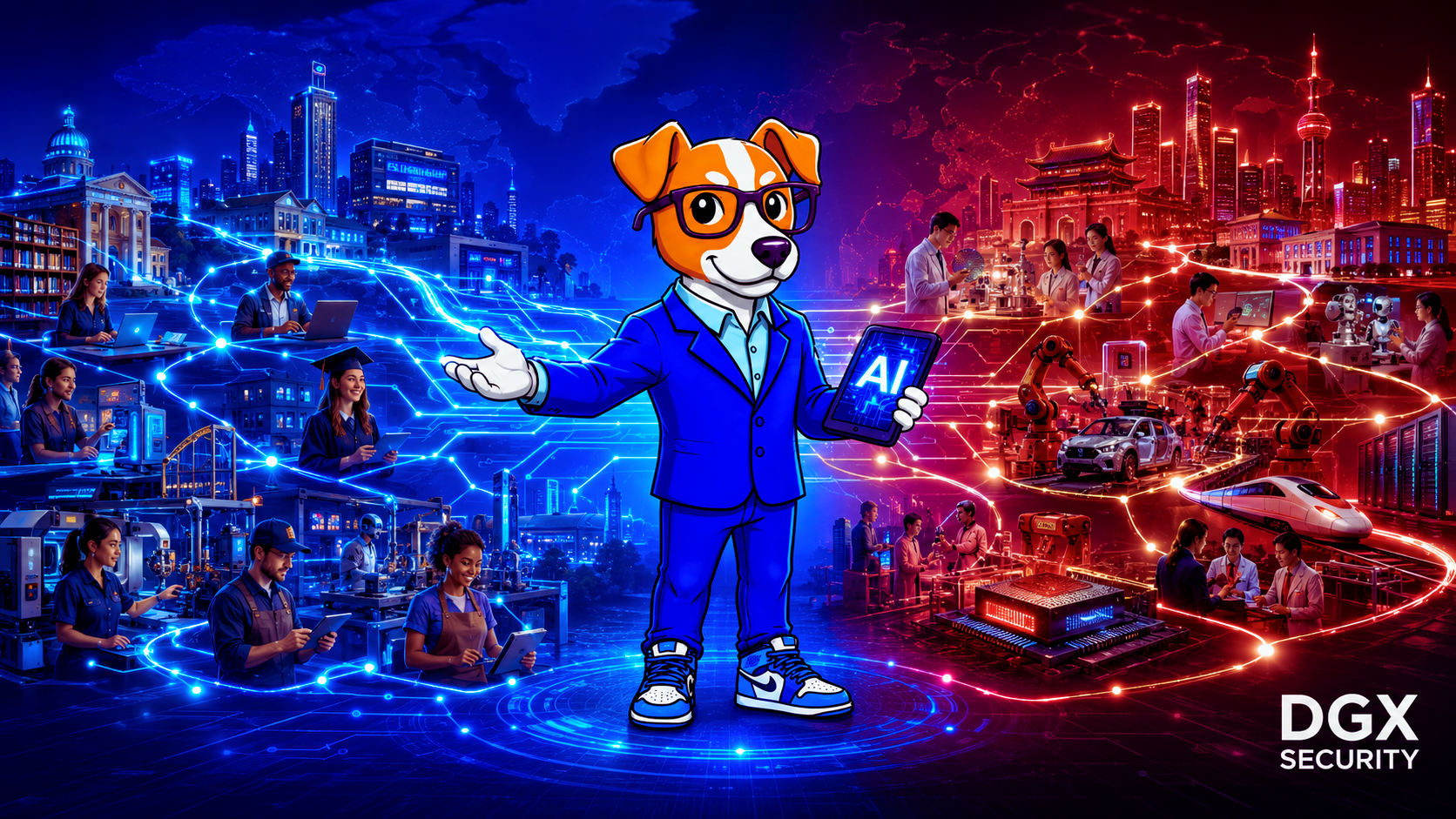
China Is Building an AI Ecosystem, Not Just AI Models.
The deepest part of Jensen Huang’s warning is not simply that China has strong universities or competitive AI companies.
China has built a thriving ecosystem in which education, research, infrastructure, manufacturing, investment, government policy and mass adoption reinforce one another.
Universities produce engineers and researchers.
Researchers generate discoveries, patents and new companies.
Technology companies turn those discoveries into models, applications and commercial products.
Manufacturers integrate AI into factories, robotics, vehicles, telecommunications equipment and consumer devices.
Government agencies support infrastructure, procurement and large-scale deployment.
A vast domestic market produces revenue, demand, experience and data, fueling the next generation of innovation.
Each part strengthens the others.
That is what an ecosystem does.
China’s open-source models are also making advanced AI more accessible to developers and businesses.
Its powerful electronics and manufacturing base allows AI to move beyond chatbots and into physical products, industrial systems, robotics and infrastructure.
This creates a compounding economic flywheel:
Research produces talent. Talent produces companies. Companies produce products.
Products increase adoption. Adoption creates revenue, productivity, and demand for more research.
The United States still has the world’s strongest frontier AI companies and deeper private capital markets.
But our AI economy is heavily concentrated in a relatively small number of corporations, technology centers, and highly educated workers.
China is working to spread AI capability across an entire industrial system.
That distinction has enormous economic implications.
AI Leadership Will Shape the Entire Economy.
Artificial intelligence is not simply another software industry.
It is becoming a general-purpose technology capable of transforming nearly every major sector:
- Manufacturing
- Healthcare
- Transportation
- Finance
- Energy
- Education
- Agriculture
- Logistics
- Media
- National defense
- Government services
- Small-business operations
The country that develops the strongest AI ecosystem will not only sell more software.
It will manufacture goods more efficiently, discover new medicines faster, operate smarter supply chains, improve energy systems, accelerate scientific research, and create entirely new industries.
Its business will become more productive.
Its workers will produce more value.
Its products will become more competitive.
Its economy will attract more capital and talent.
Its technical standards may influence how the rest of the world builds and governs AI.
Meanwhile, countries that fail to develop widespread AI capability risk becoming dependent on foreign models, platforms, equipment and standards.
They may continue consuming advanced technology while losing the capacity to create it.
That is the real economic danger.
America could remain home to several powerful AI corporations while large portions of its workforce, small-business sector and public institutions fall behind.
That would produce extraordinary wealth at the top without generating broad national strength.
A Nation Cannot Compete With Only a Small Technical Elite.
The AI race will not be decided exclusively by which company produces the most advanced model.
It will also be decided by how many people can use the technology effectively.
Can a displaced worker use AI to identify a new career and prepare for an interview?
Can a small business use it to compete for contracts, analyze markets and improve operations?
Can a teacher use it to personalize instruction?
Can a senior citizen use it safely without becoming vulnerable to fraud?
Can a housing authority, workforce board or public library bring AI access to residents who cannot afford the latest devices and subscriptions?
Can local governments and community organizations use AI to deliver better services without becoming permanently dependent on expensive outside consultants?
These are not secondary questions.
They determine whether artificial intelligence becomes productive national infrastructure or another force that widens the distance between Americans.
A country cannot maintain technological leadership while millions of its people remain spectators.
America currently possesses extraordinary AI companies, world-class researchers, and unmatched private investment.
But innovation concentrated inside a few corporations and elite universities is not enough.
We need widespread access and capability.
China’s advantage is not simply that it has more laboratories.
It has developed an enormous pipeline of engineers, researchers, students, manufacturers and technically trained workers.
It is turning population scale into technological scale.
America must respond by turning human potential into national capacity.
Access Is Now an Economic Competitiveness Issue.
The digital divide was once described primarily as a problem of Internet access.
The AI divide is more complex.
A person may technically have Internet access and still lack:
- An AI-ready device
- Reliable connectivity
- Practical instruction
- Confidence using AI tools
- Knowledge of safety and privacy
- Access to paid platforms
- Support after the initial training
Giving someone a login and showing them a presentation is not AI inclusion.
Real inclusion means providing the complete environment necessary to participate.
That is why AI literacy cannot be separated from devices, connectivity, workforce preparation, entrepreneurship, and continuing support.
The communities most vulnerable to economic disruption must be among the first equipped to use technology productively.
Otherwise, America will repeat the mistakes of earlier technological transitions: celebrating innovation at the top while leaving millions of people to absorb the consequences at the bottom.
The result would not only be greater inequality.
It would mean fewer AI-enabled workers, fewer competitive small businesses, weaker local economies, lower productivity, and a smaller domestic market for American innovation.
Broad AI adoption is therefore not merely a social goal. It is an economic growth strategy.
America Must Build Its Own Complete AI Ecosystem.
America does not need to copy China’s political system or centralized approach.
But we do need coordination.
An American AI ecosystem should connect:
- Research universities and community colleges
- Public schools and workforce-development systems
- Technology companies and small businesses
- Federal, state and local government
- Libraries, housing authorities and community organizations
- Device manufacturers and connectivity providers
- Investors, entrepreneurs and skilled workers
- Advanced research and practical community deployment
The pipeline cannot end when a new model is released.
It must extend into workplaces, classrooms, homes, small businesses and communities.
America needs more than AI invention.
It needs AI distribution, education and adoption.
America Still Has Time but Not Unlimited Time.
This is not an argument that America has already lost.
The United States continues to lead in frontier AI model development, private investment, entrepreneurship, and many forms of high-impact research.
Our universities, companies, and scientific institutions remain formidable.
But momentum matters.
Scientific and industrial leadership is built over decades through sustained investment in people and infrastructure.
Once research ecosystems, talent pipelines, manufacturing capacity and supply chains move elsewhere, they become difficult and expensive to reconstruct.
Export controls alone will not solve this problem.
Restrictions may slow a competitor’s access to particular technologies, but they cannot substitute for developing our own population and domestic ecosystem.
America cannot defend its way into permanent leadership.
It must educate, equip, and mobilize its people.
The answer is not fear of China.
The answer is renewed investment in America.
AI for All Is a National Economic Strategy.
At DGX Security, our mission is to connect one million Americans to artificial intelligence.
That mission is not based on charity.
It is based on competitiveness, productivity, and economic survival.
We believe workers, students, seniors, veterans, returning citizens, small businesses, and underserved communities must be active participants in the AI economy.
That requires more than training.
It requires AI-ready devices, reliable connectivity, practical education and continuing support. It requires partnerships among government agencies, workforce systems, housing authorities, libraries, schools, employers and community organizations.
Most importantly, it requires urgency.
The next generation of scientific and economic leadership is being built right now, in classrooms, laboratories, factories, workforce centers and communities around the world.
America once understood that broad access to education, infrastructure and technology was the foundation of national power.
We must remember that lesson.
Because the country that builds the strongest AI ecosystem and connects the greatest number of people to it will not merely have the most AI users.
It will have the most capable workforce, the most productive businesses, the most adaptable economy, and the strongest foundation for the future.
America cannot remain the world’s technology leader while millions of Americans remain outside the technology revolution.
AI for All is no longer just an aspiration. It is an economic and national security imperative.
Get the next issue: