 The DGX AI Access Brief
August 3, 2026
The AI Era Is Here. But Access Will Determine Who Benefits.
From The AI Access Brief archive · originally published 2026-08-03
Meeting people where they are means putting AI-ready technology in their hands, training them to use it, and showing them how it can improve their work, creativity, education, and everyday lives.
Artificial intelligence is no longer a distant idea waiting somewhere beyond the horizon.
It is already helping people create businesses, build websites, improve résumés, produce videos, organize their work, learn new skills, compose music, analyze information, and bring ideas to life.
For those who know how to use it, AI can expand creativity, increase productivity, save time, and open doors to new opportunities.
But those benefits are not reaching everyone equally.
For millions of people, the barrier is not simply fear or resistance.
It may be the absence of an AI-ready device, dependable internet access, trusted instruction, or any practical demonstration of how AI could improve their lives.
You cannot ask people to embrace a technology they have never had a meaningful opportunity to use.
That is why access must come first.
AI Inclusion Begins With Access.
At DGX Security, we believe AI inclusion begins by meeting people where they are.
That means more than sending someone a link to an online course or telling them that artificial intelligence is important.
It means placing technology directly into their hands, providing practical instruction, creating a supportive environment for learning, and connecting AI to goals they already care about.
Access includes the device.
Access includes connectivity.
Access includes training.
Access also includes understanding why the technology matters.
An AI tool sitting unused on a screen does not create opportunity.
The opportunity begins when a person understands how that tool can help them solve a problem, complete a task, express an idea, or move closer to a goal.
Show People What AI Can Do for Them.
People are more likely to embrace technology when they can see themselves benefiting from it.
A job seeker may want help strengthening a résumé, preparing for an interview, researching employers, or identifying positions that match their experience.
A small-business owner may want to build a website, create marketing materials, respond to customers, organize invoices, or reach a larger audience.
A student may want to understand a difficult subject, create a study guide, practice a new skill, or explore creative ideas.
A working parent may simply want to save time, organize a schedule, plan meals, write an important message, or manage a growing list of responsibilities.
A creator may want to produce images, music, animation, video, or an entire short film without access to a traditional production studio.
Technology becomes meaningful when people can see themselves using it.
That is where awareness becomes powerful.
Not awareness built around technical language, abstract predictions, or endless arguments about the future, but awareness grounded in practical possibilities.
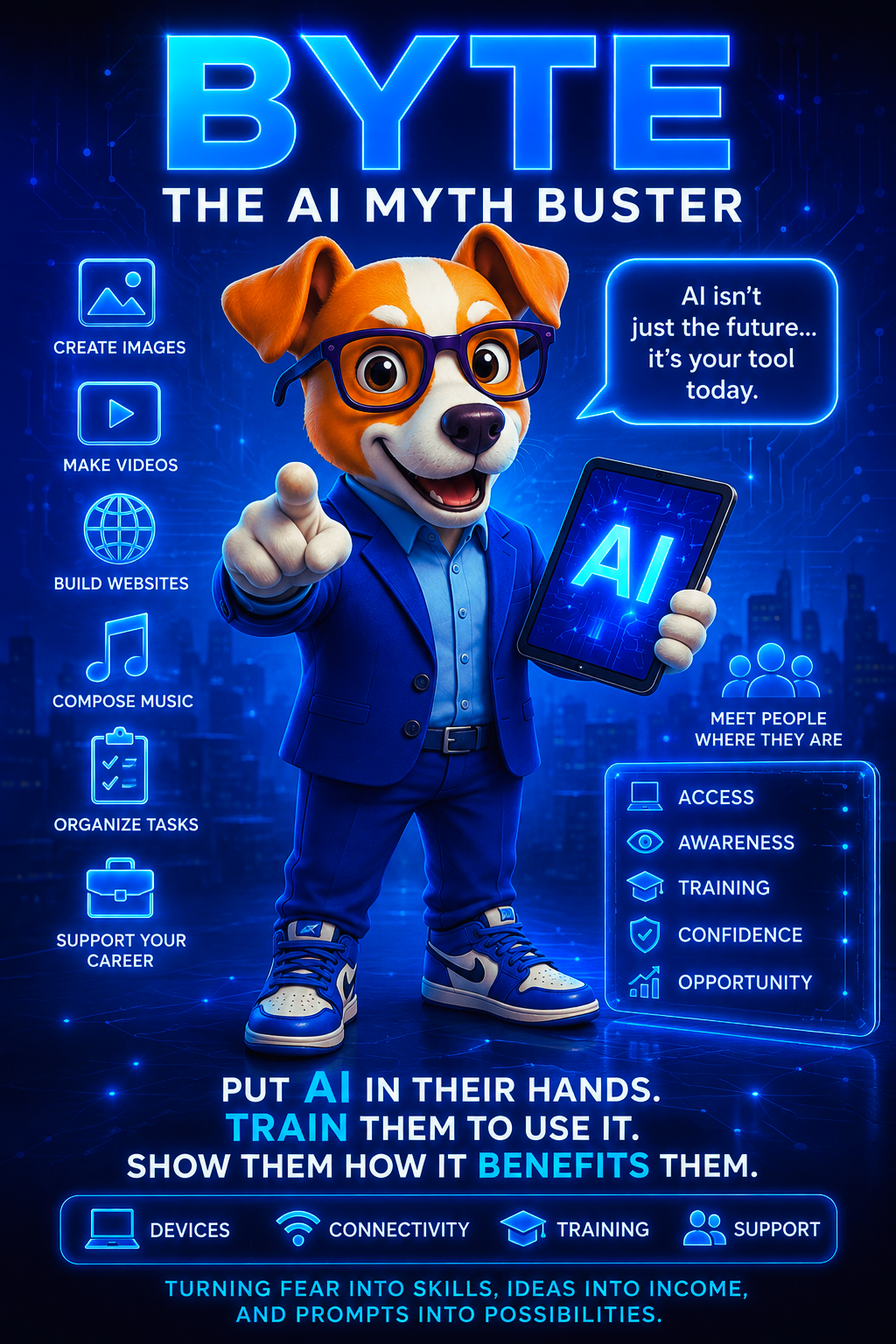
Why We Created BYTE the AI Myth Buster.
Many people have heard about artificial intelligence, but they have not yet experienced what it can do.
Some believe AI is only for programmers, technology companies, or highly trained professionals.
Others have mainly encountered stories about job displacement, misinformation, cheating, or machines replacing human beings.
Those concerns deserve serious discussion. But they should not become the only story people hear.
That is why we created BYTE the AI Myth Buster.
BYTE uses short, visual episodes to introduce AI capabilities in a way that is clear, approachable, and useful.
Each episode begins with a simple question:
What is AI image generation?
What is AI video creation?
What is an AI agent?
BYTE then shows the answer in action.
Instead of describing artificial intelligence as a mysterious black box, BYTE demonstrates how it can create an image, animate a photograph, organize tasks, improve a résumé, compose music, build a website, or turn a simple idea into a working project.
The goal is not to overwhelm people with technical terminology.
The goal is to create a spark.
Training Builds Confidence.
A short video can inspire curiosity, reduce fear, and make someone think, “Maybe I can do this.”
But lasting inclusion requires more.
People need opportunities to practice.
They need instructors who can answer questions without judgment.
They need real devices, reliable connectivity, and examples that reflect their lives.
They need time to experiment, make mistakes, and discover what works.
Most importantly, they need to understand how AI can support their own goals.
That is why our larger mission follows a clear pathway:
Access → Awareness → Training → Confidence → Opportunity.
First, people need access to devices and connectivity.
Then they need to see what AI can do.
Next, they need hands-on training that allows them to practice safely, responsibly, and confidently.
Finally, they need support applying those skills to employment, education, entrepreneurship, creativity, and everyday life.
Each stage matters.
Without access, awareness remains theoretical.
Without awareness, people may never explore the technology.
Without training, curiosity can quickly become frustration.
Without confidence, new skills may never be used.
Without a connection to opportunity, AI literacy risks becoming another certificate rather than a tool for progress.
Human Ability Still Leads the Way.
AI can generate, summarize, organize, analyze, and automate.
It can help people move from an idea to a first draft with remarkable speed.
But human beings still provide the purpose.
People bring judgment, creativity, ethics, cultural understanding, lived experience, empathy, and responsibility.
The goal should not be to remove people from the process.
It should help people become more capable within it.
A person who knows how to use AI responsibly may be able to accomplish work that once required more time, money, software, or specialized support.
That can be especially powerful for small businesses, job seekers, students, community organizations, and families operating with limited resources.
AI can help level the field, but only when access and education are intentionally built into the equation.
Building an AI-Ready Future for Everyone.
The next digital divide will not be solved by simply telling people that artificial intelligence exists.
It will not be solved by publishing more reports, launching more software, or assuming everyone will eventually figure it out on their own.
It will be solved by ensuring people have the tools, knowledge, support, and opportunity to participate.
That means meeting people where they are.
It means putting AI-ready technology in their hands.
It means training them to use it.
Most importantly, it means showing them how it benefits them.
This is the heart of DGX Security’s approach:
Put AI in people’s hands. Train them to use it. Show them how it benefits them.
The AI era is here.
The real question is whether we will build it for everyone.
Get the next issue: